- May 19, 2026
- Posted by: Véronique Genot Salmeron
- Categories: Culture at work, DEI

U.S. DEI strategy: execution matters more than intent
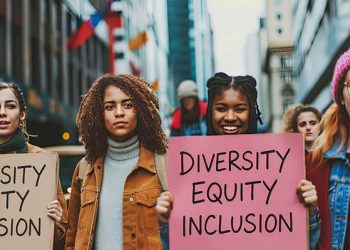
In the United States, diversity, equity, and inclusion (DEI) policies are sometimes praised for fostering social cohesion, and sometimes criticized as a form of ideological conformity. Beyond perception, this divide shows up in real outcomes: depending on how they are designed and executed, DEI initiatives can either strengthen or undermine a company.
A comparison of DEI strategies at Accenture and Disney offers an important takeaway for international teams navigating diverse legal and cultural environments: intent is not what matters most—execution is.
When DEI strategy becomes a performance driver: the Accenture case
For Accenture, a global consulting leader, diversity is not treated as a moral obligation but as a core capability—essential for solving complex client problems. This approach rests on three key pillars.
First, Accenture publishes detailed annual reports on workforce composition and pay equity by country. This radical transparency anchors its commitments over time, while many organizations remain vague about their progress. It also protects the company from accusations of “woke-washing,” where DEI efforts are seen as performative or politically driven.
Second, the company has set a clear goal of gender parity. Accenture was among the first companies of its size to commit to a 50/50 gender balance across its global workforce. By the end of 2025, women represented 49.5% of employees. This goal is supported by intensive mentoring programs and systematic reviews of hiring and promotion processes.
Finally, Accenture views inclusion as a competitive advantage and a direct driver of innovation. By investing heavily in hiring neurodivergent talent and training consultants in universal accessibility principles, the company has turned social challenges into tangible offerings such as Inclusive Design. Accessibility and inclusion have thus become new revenue streams.
This operational rigor has enabled Accenture to stay on course despite economic and political turbulence in the tech sector. By embedding DEI into its core structure, the company has shown that inclusion can become a source of stability and long-term differentiation. To achieve this, DEI must be managed like an industrial process—not a political posture.
When DEI strategy becomes a risk: the Disney case
Between 2021 and 2024, Disney made DEI a visible strategic priority through its “Reimagine Tomorrow” initiative, setting ambitious targets: 50% of characters from underrepresented groups, updated employee guidelines, and the integration of diversity metrics into manager compensation.
However, this ambition ran into execution challenges, most visibly during the release of Snow White in 2025. From early development, creative decisions related to representation (casting, storyline, supporting characters) sparked intense controversy, forcing Disney to hold a closed premiere.
While critics pointed to questionable artistic choices and a massive budget, the scale of the public backlash—including boycotts and coordinated “review bombing” campaigns on IMDb—reflected a broader fatigue among parts of the American audience toward the politicization of cultural content. The result was one of the biggest commercial failures in Disney’s history, with estimated losses of $168 million, plus nearly $100 million in marketing to counter negative press.
This episode followed an open conflict with Florida Governor Ron DeSantis. In 2022, DeSantis signed a law restricting the teaching of gender identity and sexual orientation in schools. Under pressure from employees, then-CEO Bob Chapek publicly criticized the law. In retaliation, DeSantis moved to strip Disney of control over the Reedy Creek district, which had governed its theme park operations.
In the aftermath, Disney’s image as a universally appealing family brand was significantly damaged. The company gradually walked back its DEI commitments: “Reimagine Tomorrow” was removed from its SEC filings in late 2024, and diversity criteria were dropped from manager evaluations. This abrupt reversal triggered further criticism, both internally and externally.
This case highlights a common pitfall: a DEI strategy positioned as a top priority, but not grounded in value creation, can backfire—spectacularly and durably.
Conclusion: from intent to strategic alignment
Taken together, these examples show that DEI is neither a silver bullet nor an inherent risk. It is a management tool whose effectiveness depends on alignment with brand identity and market expectations.
At Accenture, DEI works because it is treated as an operational discipline embedded in the company’s core systems. Inclusion is not about reshaping client values, but about enhancing the organization’s ability to solve complex problems. This consistency enables resilience in a highly polarized environment.
By contrast, Disney’s experience underscores the risks of DEI perceived as ideological compliance that disrupts brand identity. When execution clashes too directly with audience expectations and cultural attachment, DEI shifts from a lever to a liability—one that can be costly and destabilizing.
For international organizations, the lesson is twofold:
• Rigor before messaging. DEI must be driven by performance and transparency (as in the Accenture model), not by morally charged communication. Only once a coherent and effective strategy is in place should it be promoted externally.
• Respect the cultural contract. Any evolution must remain anchored in the company’s value proposition. Ignoring market sensitivities in a polarized environment can fragment audiences and erode long-term trust.
The real question is not just how to integrate diversity, but how to do so without breaking the vital connection between a company and its audience—and without incurring the costs of polarization. Only with this level of cultural awareness can DEI become a sustainable performance driver.
For HR Leaders and Managers
For HR leaders and managers, the challenge is now operational: turning abstract principles into concrete performance drivers, while avoiding cultural and reputational pitfalls.
This is exactly what we will explore in our June 18 seminar. Through real-world case studies, peer discussions, and actionable tools, you will leave with a clear framework and practical approaches tailored to your context.
If you want to move from intent to disciplined execution, register now:
https://birdwellgroup.com/intercultural/fr/ateliers/comprendre-les-politiques-de-diversite-dequite-et-dinclusion/

Leave a Reply
Would your company like to organize an intercultural coaching session?
Latest blog posts
-

Managing Time as an Intracultural Challenge within Brazil
September 15, 2026 -
U.S.A. The monolingual superpower?
September 1, 2026 -

US vs France Vacation Culture: what we can learn in 2026
June 30, 2026 -

Accents: the music of humanity
June 9, 2026 -

ENGLISH: The Most Successful Language in History?
March 25, 2026