- March 31, 2026
- Posted by: Véronique Genot Salmeron
- Category: DEI
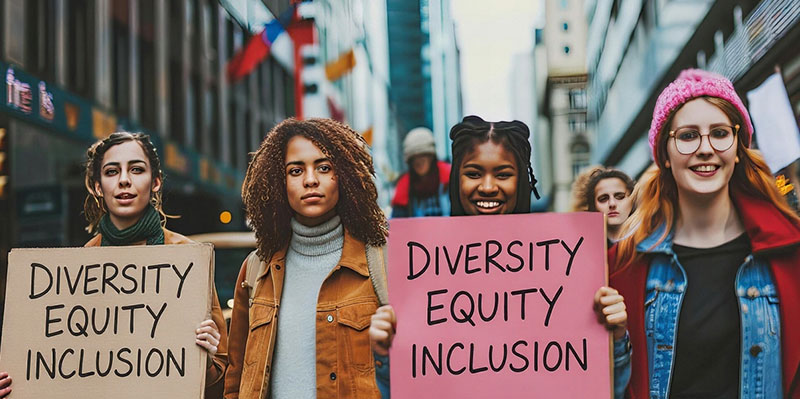
How did diversity policies become a strategic priority for American companies?
This article provides historical context to better understand diversity policies in the United States and their implications for international organizations.
During an exchange between a French subsidiary and its American headquarters a few years ago, one question led to an unexpected silence:
“Could you provide us with the ethnic breakdown of your teams?”
For the American participants, the request was routine. For the French HR managers, it was legally impossible and culturally unsettling.
This brief moment of hesitation revealed something deeper than a simple administrative misunderstanding. It highlighted two different histories, two conceptions of equality, and two visions of the role of business in society.
To understand these gaps, we need to go back to the origins of DEI in the United States.
The Emergence of Diversity Policies in the United States
Diversity, Equity, and Inclusion did not originate in corporations, but in the civil rights movement.
In 1964, the Civil Rights Act marked a historic turning point. It prohibited discrimination based on race, religion, sex, or national origin in public spaces and employment. Legally, it brought an end to institutional segregation.
However, banning discrimination was not enough to correct a legacy of inequality.
Under the presidency of Lyndon B. Johnson, “affirmative action” policies introduced a new logic: achieving real equality sometimes requires corrective measures. The idea of more balanced representation for historically marginalized groups gradually took hold in universities, and later in corporations.
From Legal Compliance to Business Strategy
In the 1970s and 1980s, large American companies developed internal programs to comply with legal requirements. The initial goal was clear: avoid litigation and demonstrate equal opportunity.
Gradually, however, diversity became more than a legal or moral obligation—it became a strategic asset. A diverse workforce was seen as a way to better understand increasingly diverse markets, attract a wider talent pool, and foster innovation.
In the 1990s, the concept of “inclusion” emerged: it was no longer enough to hire diverse profiles; organizations also needed to create environments where individuals could fully contribute and feel valued.
In the 2010s, the notion of “equity” completed the framework. Unlike equality (treating everyone the same), equity involves adjusting rules or resources to address structural disadvantages.
DEI thus became a fully developed strategic framework, embedded in HR policies and, in some cases, corporate governance.
2020: A Turning Point and a Catalyst
The death of George Floyd marked another major turning point. The Black Lives Matter movement pushed many American companies to strengthen their commitments and invest heavily in DEI—amounting to tens or even hundreds of billions of dollars.
Internal audits, representation targets, and dedicated investments: DEI moved beyond the scope of HR to become a top-level strategic issue.
At the same time, this acceleration sparked debate. Some initiatives were criticized for being symbolic or lacking effectiveness. Critics argued that they risked replacing one form of discrimination with another.
In 2023, the Supreme Court challenged admissions policies that explicitly considered race at Harvard, underscoring the ongoing legal and political sensitivity of the issue.
Upon returning to the White House, Donald Trump signed executive orders aimed at ending most DEI programs at the federal level and in public contracts, significantly reducing their institutional presence.
DEI in the United States is therefore strategic, institutionalized—and highly contested.
A Different French Trajectory
In France, the republican ideal is based on a universalist conception of equality: the law recognizes citizens, not communities. The collection of ethnic data is strictly regulated and, in practice, unusable as an HR management tool. Equality is understood as an abstract and indivisible principle.
Where the American model accepts categorization as a way to correct historical inequalities, the French model remains cautious about institutionalizing identity-based distinctions.
In the United States, the legacy of segregation places race at the center of public debate.
In France, skepticism toward categorization is rooted in a different political and institutional history.
These legacies continue to shape managerial practices today.
Two Conceptions of Organizational Justice
Behind the acronyms lie two distinct ways of thinking about fairness in the workplace.
The American model tends to view collective history as a justification for explicit and measurable corrective policies.
The French model prioritizes equal treatment and is wary that emphasizing categories may fragment the collective.
Thus, when a U.S. headquarters requests detailed diversity metrics, it may see them as a strategic management tool. When a French manager expresses reservations, they may be acting in alignment with their legal and cultural framework.
Understanding Before Adopting
In a globalized business environment, these differences are no longer theoretical. They shape executive meetings, recruitment policies, and discussions about corporate culture.
The question is not whether DEI should be addressed in France, but rather how to understand where this model comes from, what it means in its original context, and whether it can be adapted.
Understanding DEI is not just about understanding an HR tool—it is about understanding two collective histories, two conceptions of equality, and two visions of the social role of business.
It is therefore essential to decode the underlying logic in order to act with clarity and discernment.
This article serves as an introduction to the seminar “Understanding DEI in International Organizations”, which provides an in-depth analysis of the history and contemporary implications of diversity policies in the United States within global organizations.

Leave a Reply
Would your company like to organize an intercultural coaching session?
Latest blog posts
-

Managing Time as an Intracultural Challenge within Brazil
September 15, 2026 -
U.S.A. The monolingual superpower?
September 1, 2026 -

US vs France Vacation Culture: what we can learn in 2026
June 30, 2026 -

Accents: the music of humanity
June 9, 2026 -

ENGLISH: The Most Successful Language in History?
March 25, 2026