- June 30, 2026
- Posted by: William BIRDWELL
- Categories: American culture, Culture at work, French culture
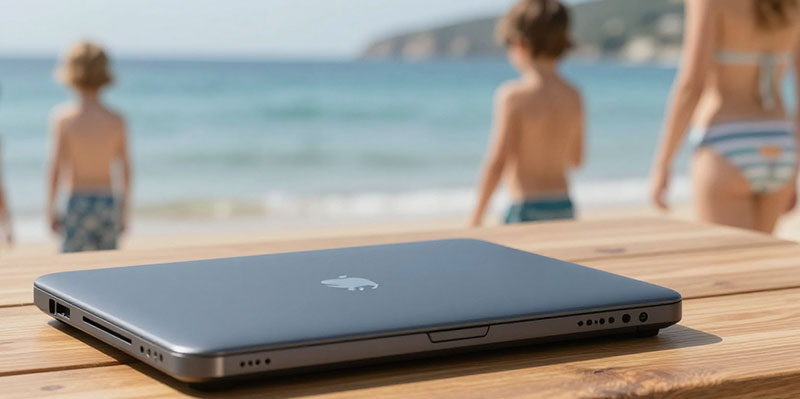
Vacation, PTO and freedom: what France and the United States can learn from each other in 2026
Americans live to work; the French work to live. It is an appealing phrase—but also an oversimplification.
It feels as though I wrote this article only yesterday, yet more than a year has passed. Time moves quickly. Like Christmas, summer vacations seem to return almost before we realize they have gone.
As we approach the summer of 2026—a symbolic year marking the 250th anniversary of American independence—it is worth asking: What does freedom mean today? In 1776, freedom meant political independence. In 2026, for many employees, freedom also means something far quieter: being able to take time off without guilt, to rest without feeling the need to justify it, and to avoid answering emails from a beach, a farm, or the family home.
After more than forty years living in France, I remain fascinated by the striking difference in vacation culture on either side of the Atlantic. Paid leave is not simply a matter of labor law. It reveals our priorities, our fears, our relationship with time, and even our definition of success.
My Journey
I grew up on a large farm in the southeastern United States. Summer was never synonymous with rest—it meant work. There was always something to repair, harvest, transport, or watch over. Family vacations were a luxury that seemed reserved for other people.
When I arrived in France forty-one years ago, I was astonished to discover that even entry-level employees were legally entitled to five weeks of paid vacation. My first reaction was typically American: How can an advanced economy function if everyone disappears in August?
Eventually I realized that perhaps the better question was the opposite: How can an economy function sustainably if nobody ever truly stops working?
The American model: PTO as a negotiated benefit
In the United States, there is still no federal guarantee of paid vacation. Paid Time Off (PTO) depends entirely on the employer. It often combines vacation, sick leave, and personal days into one bank of time. After one year of employment, the average private-sector worker receives around eleven days of paid leave, sometimes supplemented by additional sick or personal days depending on the company.
But the American challenge is not simply the number of days available—it is cultural.
According to the Pew Research Center, 46 percent of American employees who receive PTO fail to use all of it. Their reasons are revealing: fear of falling behind, concern about burdening colleagues, anxiety about appearing less committed, or simply believing they do not “really need” more time off.
In many American companies, taking one week off seems perfectly acceptable. Taking two consecutive weeks often requires an explanation. Taking three weeks can almost feel like declaring independence.
The French Model: Vacation as a Collective Right
In France, paid vacation is deeply rooted in both the law and the national culture. Employees are entitled to a minimum of five weeks of paid leave, often supplemented by RTT days for those working beyond the 35-hour workweek.
During July—and especially August—offices slow down, automatic email replies multiply, and much of the country collectively presses pause.
From an American perspective, this can appear excessive. Working with American companies operating in France, I have often heard the same joke:
“The French are always on vacation!”
Yet this overlooks an important reality. Many French technicians, engineers, managers, and executives work extraordinarily hard. Ten- or twelve-hour days are far from uncommon during busy periods. Long vacations are therefore not necessarily a sign of laziness—they are often the essential counterbalance to highly concentrated periods of work.
The paradox: Americans have less vacation but may need less recovery
A French engineer I met on a flight from Paris to New York offered an interesting perspective.
Working in the United States, he acknowledged having fewer vacation days than he had enjoyed in France. Yet he also admitted feeling less exhausted. His workdays were shorter, meetings more efficient, and Friday afternoons noticeably quieter.
He had fewer vacations—but he also felt less need to disappear for three weeks to recover.
It is a counterintuitive idea. Perhaps the French do not simply enjoy more vacation because they value leisure more. Perhaps they also need it because their work rhythm can be particularly intense, demanding, and psychologically draining.
Conversely, some Americans receive fewer vacation days but experience workdays that are often more pragmatic, faster paced, and less ritualized. This is certainly not always the case. Many Americans work excessively long hours with little job security. Nevertheless, it reminds us that comparing vacation calendars alone tells only part of the story. We must also compare the energy expended throughout the year.
The real question: can we truly disconnect?
In 2026, perhaps the debate should no longer be, “How many vacation days do you have?”
The more important question is:
“Are you really away when you’re away?”
A French employee with five weeks of vacation who continues answering work emails from the beach is not truly free.
An American employee with only ten days of PTO—but who completely disconnects—may actually return far more refreshed.
The modern trap is that work no longer stays at the office. It fits into our pockets. Smartphones have transformed vacations into “half-vacations.”
We are not officially working—we are simply “keeping an eye on things.”
We are not really responding—we are just “checking quickly.”
We are not resting—we remain permanently available.
Yet constant availability is not commitment. It is often poor organization disguised as professionalism.
1776–2026: another definition of freedom
The 250th anniversary of the United States provides a wonderful opportunity to rethink the meaning of freedom.
Americans have built an admirable culture based on initiative, ambition, and personal responsibility. But that culture can become counterproductive when it transforms rest into a sign of weakness.
France, on the other hand, has long defended the idea that certain rights must be collective if they are to be genuinely accessible. Paid vacation is a perfect example. When an entire society slows down together, individuals no longer feel guilty about taking time off.
Perhaps that is France’s greatest lesson:
Rest works best when society gives us permission to rest.
Three Ideas for 2026
• First, American companies should stop treating vacations as a reward. Rest is not a bonus—it is part of the infrastructure of long-term performance.
• Second, French companies should do more to protect genuine disconnection. Five weeks of vacation mean little if constant digital interruptions eliminate the benefits.
• Third, both cultures should abandon their stereotypes. Americans are not all workaholics. The French are not lazy. Both societies are trying to solve the same challenge:
How can people work intensely without wearing themselves out?
Conclusion
Vacations are not an escape from work.
They are one of the conditions that make long, productive careers possible.
Americans can learn from the French that rest should be legitimate, visible, and embraced.
The French can learn from Americans that greater day-to-day efficiency may reduce the need for lengthy periods of recovery.
In 2026, as America celebrates 250 years of freedom, perhaps it is time to broaden the definition.
Freedom is not only the ability to work hard.
It is also the ability to stop, breathe, reconnect with family, body, and mind—and return with genuine energy.
Long live vacations. And above all, long live real vacations.

Leave a Reply
Would your company like to organize an intercultural coaching session?
Latest blog posts
-

Managing Time as an Intracultural Challenge within Brazil
September 15, 2026 -
U.S.A. The monolingual superpower?
September 1, 2026 -

Accents: the music of humanity
June 9, 2026 -

ENGLISH: The Most Successful Language in History?
March 25, 2026