- September 1, 2026
- Posted by: William BIRDWELL
- Category: American culture
How America became the World’s most linguistically diverse nation — yet struggles to teach languages systematically
It’s one of the most persistent global stereotypes: Americans only speak English.
Compared with many Europeans or Asians — where bilingualism is common — the perception feels justified.
But here’s the paradox:
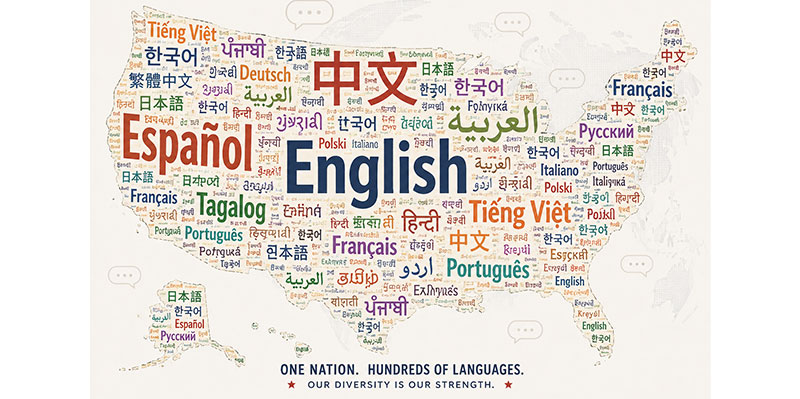
The United States is probably the most linguistically diverse country in the world.
According to the U.S. Census Bureau’s 2022 American Community Survey, 22.3% of people age 5 and older report speaking a language other than English at home — the highest share in U.S. history. The data show over 500 languages and language groups spoken across the country.¹
And yet, systematic language learning in the education system remains weak.
A Multilingual Population — But Not a Multilingual System
Languages Spoken at Home in the U.S.
• Spanish: ~41 million speakers
• Chinese languages (Mandarin, Cantonese, etc.): ~3.5 million
• Tagalog: ~1.7 million
• Vietnamese: ~1.5 million
• Arabic: ~1.2 million
Smaller but significant language communities include Haitian Creole, Punjabi, Korean, Russian, Somali, and dozens of Indigenous languages.
This far surpasses many European countries in sheer linguistic variety — yet Americans are less likely to study a second language formally.
Language learning in K–12: 0ptional and uneven
Unlike France or China, the United States has no national requirement to begin foreign language instruction at a defined age.
A 2020 survey of school districts reported:
• Only 14% of elementary schools offer foreign language instruction.²
• Fewer than 47% of middle and high school students enroll in a foreign language course.³
When languages are offered, they tend to be traditional European options (Spanish, French), with less access to languages of rising global importance (Arabic, Mandarin, Hindi).
University language enrollments are shrinking
At the university level, the data point to a concerning decline.
According to the Modern Language Association’s national report on language enrollment:
• *Enrollments in languages other than English dropped ~16.6% between 2016 and 2021.*⁴
• This represents a loss of more than 236,000 enrollments in five years.⁴
• Meanwhile, overall undergraduate enrollment decreased only about 8% during the same period.⁴
Foreign language programs in U.S. colleges are disappearing:
• From 2013 to 2016, more than 650 foreign-language programs closed nationwide.⁵
• Nearly every region — Northeast, Midwest, South, and West — reported program reductions.⁵
This is not limited to “less popular” languages; even degrees in languages like Portuguese and Arabic have been dropped in favor of programs perceived as more ‘marketable.’
English composition and the humanities are also under pressure
The contraction isn’t limited to foreign languages. Humanities majors — including English composition, literature, and philosophy — have experienced steep declines.
Between 2012 and 2022:
• English and Literature majors declined by ~17%
• History declined by ~24%
• Foreign Languages declined by ~28%
These shifts coincide with a surge in STEM and business majors, driven by market signals and student preferences.⁶
This trend is not inherently negative — but the decline in writing, critical thinking, and global communication capacities has broad implications for cross-cultural competence.
Why study abroad matters — but still isn’t enough
Study abroad has traditionally been one of the most effective pathways to language fluency.
American universities send hundreds of thousands of students overseas annually:
• In 2019, over 341,000 U.S. students studied abroad — the highest number on record.⁷
• Of these, **the most common languages studied were Spanish, French, Italian, and Chinese.**⁷
Still, study abroad participation represents only a small fraction of all college students — about 10% in a typical year.⁷
Moreover, access remains unequal. Students at well-endowed private universities are disproportionately represented, while community college and first-generation students participate at much lower rates.
Federal initiatives like the Critical Language Scholarship (CLS) and Boren Awards aim to expand access to intensive language study abroad in strategically important languages. CLS, for example, funds immersive summer programs in Arabic, Mandarin, Hindi, Korean, Persian, Russian, and other underrepresented languages.
While powerful, these programs serve only a few hundred students annually — a small fraction of the population that could benefit from deep language study.
Stronger outcomes — in unexpected places
Ironically, some of the strongest language outcomes in the United States come not from public universities but from religiously affiliated institutions.
Examples of Mission-Driven Multilingualism
Brigham Young University (BYU)
• BYU (Church of Jesus Christ of Latter-day Saints) requires most students to complete two years of language study.
• Many students complete 18–24 months of immersive missionary service abroad, often achieving strong speaking proficiency in languages from Portuguese and Spanish to Mandarin, Korean, and even less commonly taught languages like Indonesian or Wolof.
This has made BYU a leading U.S. institution in terms of language enrollment and proficiency outcomes.
Georgetown University (Jesuit-Affiliated)
• Georgetown’s emphasis on global engagement and international diplomacy has translated into deep investment in language study and cultural immersion.
• Foreign languages and international relations are core parts of the curriculum, producing graduates with advanced competence in languages such as Arabic, Chinese, Russian, and Portuguese.
These examples reveal a clear pattern: when language learning is integrated into institutional mission, proficiency increases.
Comparisons that highlight the gap
• Foreign language instruction begins in primary school.
• Students typically study one or more foreign languages throughout mandatory education.
• By the end of secondary school most French students have at least two languages under their belt.
• English is compulsory from primary school.
• Curriculum standards aim for measurable proficiency at each grade level.
• English examinations form a central part of high school and college entrance exams.
In both contexts, language learning is structural, not optional.
In the United States, it is the reverse: optional, uneven, and often extracurricular.
The strategic price of complacency
The U.S. does not lack linguistic diversity.
It lacks linguistic coherence in education policy.
In a world where:
• China’s Belt and Road Initiative spans continents,
• Africa’s population is projected to exceed that of Europe by 2027,
• Latin America continues to deepen economic integration,
language skills are not luxury — they are leverage.
Yet U.S. policy and practice increasingly treat language education as an elective rather than infrastructure.
The “monolingual superpower” narrative is partially myth — because millions of Americans are multilingual in practice.
But it is also policy truth — because the system fails to treat languages as strategic assets.
The real question is no longer whether Americans can be multilingual.
It is whether the country will treat language learning as essential — on par with technology, engineering, and data science — rather than as an optional add-on.
Because nations that communicate broadly tend to lead broadly.
And right now, America has the raw human potential.
What it lacks is the structure to match.
Sources
-
- U.S. Census Bureau, American Community Survey, 2022
- AAPPL/ACTFL Foreign Language Enrollment Survey, 2020
- American Councils on the Teaching of Foreign Languages (ACTFL)
- Modern Language Association Enrollment Report, 2016–2021
- Chronicle of Higher Education Report on Language Program Closures
- National Center for Education Statistics Degree Trends, 2012–2022
- Open Doors Report on International Education, 2019

Leave a Reply
Would your company like to organize an intercultural coaching session?
Latest blog posts
-

Managing Time as an Intracultural Challenge within Brazil
September 15, 2026 -

US vs France Vacation Culture: what we can learn in 2026
June 30, 2026 -

Accents: the music of humanity
June 9, 2026 -

ENGLISH: The Most Successful Language in History?
March 25, 2026